Tel: +86-21-57241600 / +86-21-57242700 / +86-21-57244166 E-mail: kr@shkangrui.com
English
- All
- Product Name
- Product Keyword
- Product Model
- Product Summary
- Product Description
- Multi Field Search


What is an Adaptable Box?
An adaptable box is a versatile electrical enclosure designed to safely house cable junctions, terminations, and other components like relays or timers .Electricians rely on because its configurable knockouts allow for flexible cable entry, making it suitable for various applications from residential to industrial settings. Its defining feature is allow an electrician to create cable entry points exactly where needed during installation . This on-site adaptability is the key difference from a standard junction box with fixed holes.
Adaptable Box Materials
These boxes are built from various materials to suit different environments:
Plastic (e.g., PVC, Polycarbonate): Lightweight, corrosion-resistant, and often UV-stabilized for outdoor use .
Metal (e.g., Galvanised or Stainless Steel): Offers superior mechanical protection and is used in industrial settings or where extra durability is required .
Many are also rated for weatherproofing (e.g., IP65, IP66) to protect against dust and water jets, making them suitable for outdoor or harsh environments .
Why Electricians Rely on Them
Electricians choose adaptable boxes for their practicality, safety, and compliance:
Flexibility: The knockout design simplifies wiring in complex installations, saving time and hassle on site .
Safety & Protection: They provide a secure, earthed enclosure that protects wiring from environmental factors and prevents accidental contact with live parts .
Adaptable Box vs. Junction Box
In practice, the terms are often used interchangeably, but a key distinction exists:
Standard Junction Box: Typically has pre-formed, fixed cable entry points.
Adaptable Box: Primarily featuresknockout blanks, allowing electricians to create custom entry points on any face of the box to match the exact cable routing needed .
Key Applications
Adaptable boxes are used across a wide spectrum of projects :
Residential: Terminating submain cables to sheds or garages, garden lighting, and outdoor power outlets .
Commercial: Housing wiring for fire alarm systems, signage, car park lighting, and control relays .
Industrial: Protecting connections in manufacturing, water treatment, and food processing plants, often using stainless steel for hygiene and corrosion resistance .
Practical Considerations for Installation
Choosing the right box for the job is crucial:
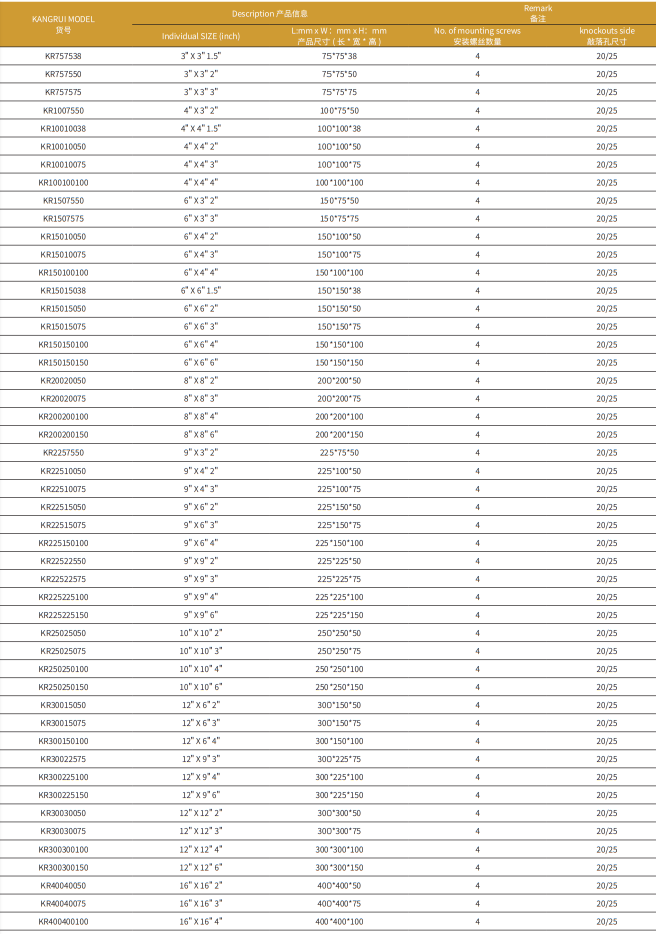
Sizing: Choose a box large enough for the current needs and any future additions. Deeper boxes offer more room for complex wiring and components like DIN rails .
IP Rating: Match the Ingress Protection rating to the environment. For example, IP65 is dust-tight and recommended for fully exposed outdoor locations, while IP56 is suitable for sheltered outdoor areas .
Sealing: For a weatherproof installation, it's critical to properly seal all cable entries with IP-rated glands and use sealant around the box perimeter .
I hope this gives you a clear understanding of what adaptable boxes are and why they are a staple for electricians. If you're looking at a specific application, like a job outdoors or in an industrial setting, feel free to ask for more tailored advice.